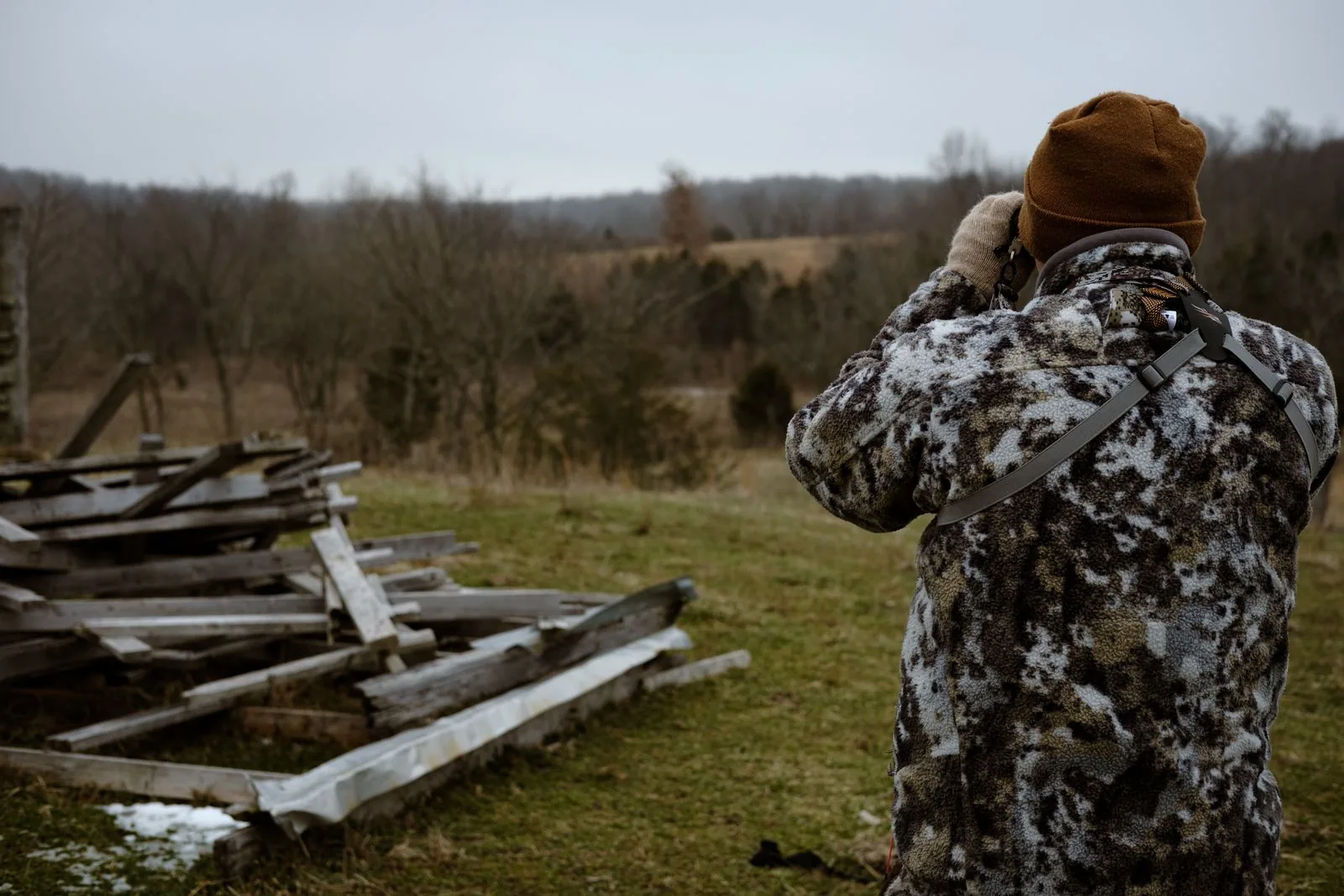
The two numbers on binoculars are magnification and lens size.
In 8×42, the 8 means things look eight times closer, and the 42 means each front lens is 42 millimeters (mm) across.
Divide the second number by the first and you get the one number that actually tells you how bright the view will be at dawn and dusk.
This guide shows you how to do that math, how to match it to your own eyes (which change with age), and how to read the smaller markings like “393 ft/1000 yds” too.
The quick decoder: 8×42 in plain words
The first number is magnification, also called “power.”
At 8x, a deer 800 yards away looks about as big as it would at 100 yards with your bare eyes.
The second number is the objective lens diameter, meaning the width of each big front lens in millimeters.
A bigger front lens catches more light, but it also makes the binoculars heavier and bulkier.
If you see a range like 8-24×50, that’s a zoom model: the power goes from 8x to 24x, and the front lens is 50 mm.
Astronomics, a long-running optics dealer, calls 10x the practical maximum for hand-held use, because higher power magnifies every shake of your hands too.
The hidden third number: exit pupil (lens size ÷ power)
Exit pupil is the width of the little beam of light that comes out of each eyepiece.
You find it by dividing the lens size by the power, so 8×42 gives 42 ÷ 8 = 5.25 mm.
Hold binoculars at arm’s length toward a bright sky and you can see it… it’s the small bright circle floating in each eyepiece.
In daylight, exit pupil barely matters, because your own pupil shrinks to a few millimeters and can’t use a bigger beam anyway.
At first and last light, it’s the number that decides whether you can still make out antlers in the shadows.
Match the exit pupil to your eyes, not to the box
Your eye’s pupil can only take in a beam as wide as it opens, and that opening shrinks as you get older.
A study of 263 adults measured average dark-adapted pupil size (pupil width after a couple of minutes in near darkness) by age:
| Age | Average dark-adapted pupil | Exit pupil that still pays off |
|---|---|---|
| 20-29 | 7.33 mm | up to about 7 mm |
| 30-39 | 6.64 mm | up to about 6.5 mm |
| 40-49 | 6.15 mm | up to about 6 mm |
| 50-59 | 5.77 mm | up to about 5.5 mm |
| 60-69 | 5.58 mm | up to about 5.5 mm |
| 70-79 | 5.17 mm | up to about 5 mm |
These are averages, and the same study found wide spread inside every age group.
Sky & Telescope puts it bluntly: if your pupil only opens to 5 mm, 7×50 binoculars act like 7x35s, because the outer part of the beam lands on your iris instead of in your eye.
So a hunter in their 50s gets little extra brightness from a 7 mm exit pupil, while the extra glass still adds weight around the neck.
A younger shooter, on the other hand, can actually use that bigger beam at dusk.
Common sizes side by side
Here’s the math done for the sizes you’ll see most often.
Twilight factor is the square root of power × lens size; higher means you can pick out more detail in dim light.
Relative brightness is the exit pupil squared, a common way to compare how bright two models look.
| Size | Exit pupil | Twilight factor | Relative brightness | Typical use |
|---|---|---|---|---|
| 8×25 | 3.1 mm | 14.1 | 9.8 | Pocket, daylight only |
| 8×32 | 4.0 mm | 16.0 | 16 | Light all-day carry |
| 8×42 | 5.25 mm | 18.3 | 27.6 | All-round, woods, dawn/dusk |
| 10×42 | 4.2 mm | 20.5 | 17.6 | Open country, more detail |
| 7×50 | 7.1 mm | 18.7 | 51 | Low light for young eyes, boats |
| 10×50 | 5.0 mm | 22.4 | 25 | Low light plus detail |
| 12×50 | 4.2 mm | 24.5 | 17.4 | Long-range glassing, brace it |
| 15×56 | 3.7 mm | 29.0 | 13.9 | Tripod glassing |
Every value in this table is calculated from the two numbers on the box, using the formulas Astronomics publishes.
Notice how 8×42 and 10×50 land at almost the same exit pupil, while 10×50 wins on twilight factor and loses on weight.
Twilight factor favors higher power, so don’t use it alone: a 15×56 scores highest but is hard to hold steady without a tripod.
Field of view: the number printed in small type
Field of view tells you how wide a slice of the world you see without moving the binoculars.
Makers print it one of three ways: in degrees (like 7.0°), in feet at 1,000 yards, or in meters at 1,000 meters.
To turn degrees into feet at 1,000 yards, multiply by about 52.4.
So 7.0° works out to roughly 367 feet wide at 1,000 yards.
To turn degrees into meters at 1,000 meters, multiply by about 17.5; Nikon’s own example gives 122 m for a 7.0° model.
The width scales with distance, so 367 feet at 1,000 yards is about 37 feet at 100 yards.
Higher power usually means a narrower field, which is why a 12x is harder to find a moving animal with than an 8x.
You may also see “apparent field of view.”
That’s the real field times the power, and Nikon notes that above 65° it’s usually sold as “wide angle.”
Other markings you’ll run into
A few more labels show up on spec sheets, and each one has a plain meaning:
- Eye relief (mm): how far your eye can sit from the eyepiece and still see the full picture; glasses wearers want more of it.
- Close focus: the nearest distance the binoculars can focus, handy for birds or tracks up close.
- Interpupillary distance (IPD): the range of eye spacing the hinge can fit; if it doesn’t match your eyes, you’ll see a shadow in one side.
- Waterproof / fog-proof: the body is sealed and usually filled with dry gas so the inside doesn’t fog when you walk from a warm truck into the cold.
Eye relief works the same way on binoculars as on a rifle scope, which we cover in what eye relief is and how much you need.
How to pick a size in 30 seconds
Start with when you’ll use them most.
If you glass mostly at first and last light, aim for an exit pupil close to your own pupil size from the age table above.
If you mostly use them in full daylight, exit pupil barely matters, so save weight with a 32 mm or smaller lens.
If you hunt thick woods, take 8x: the wider field makes it easier to find an animal moving between trees.
If you glass open country or check targets at the range, 10x shows more detail, and 12x or more is best braced on a pack or tripod.
If you carry them all day, weight is the tie-breaker, and 8×42 is the usual middle ground for a reason.
Scopes use a similar code with a few twists, explained in what the numbers on a scope mean.
FAQ
Is 8×42 or 10×42 better?
8×42 is brighter in low light (5.25 mm vs 4.2 mm exit pupil) and gives a wider, steadier view.
10×42 shows more detail at distance but shakes more when hand-held.
What does 10×50 mean on binoculars?
It means 10 times magnification and 50 mm front lenses, which gives a 5 mm exit pupil.
Do bigger numbers mean better binoculars?
No, the numbers describe size and power, not quality.
Glass quality, coatings and build don’t show up in those two numbers at all.
What does the field of view number like 393 ft/1000 yds mean?
It means the view is 393 feet wide at 1,000 yards, which is about 7.5°.
Sources
- PubMed, “Dark-Adapted Pupil Diameter as a Function of Age Measured with the NeurOptics Pupillometer”: https://pubmed.ncbi.nlm.nih.gov/20506961/ (checked 2026-11-05) – pupil sizes by age
- Sky & Telescope, “A Pupil Primer”: https://skyandtelescope.org/astronomy-equipment/a-pupil-primer/ (checked 2026-11-05) – 7×50 acting as 7×35 with a 5 mm pupil
- Astronomics, “Some Binocular Specifications”: https://astronomics.com/pages/some-binocular-specifications (checked 2026-11-05) – exit pupil, relative brightness, twilight factor, 10x hand-held limit
- Nikon, “Field of view” (Basic Information about Binoculars): https://imaging.nikon.com/sport-optics/guide/binoculars/basic/basic_08/ (checked 2026-11-05) – real/apparent field, 65° wide-angle, 122 m example
- Field-of-view conversions (52.4 ft and 17.5 m per degree) and all table values: calculated by us from the formulas above