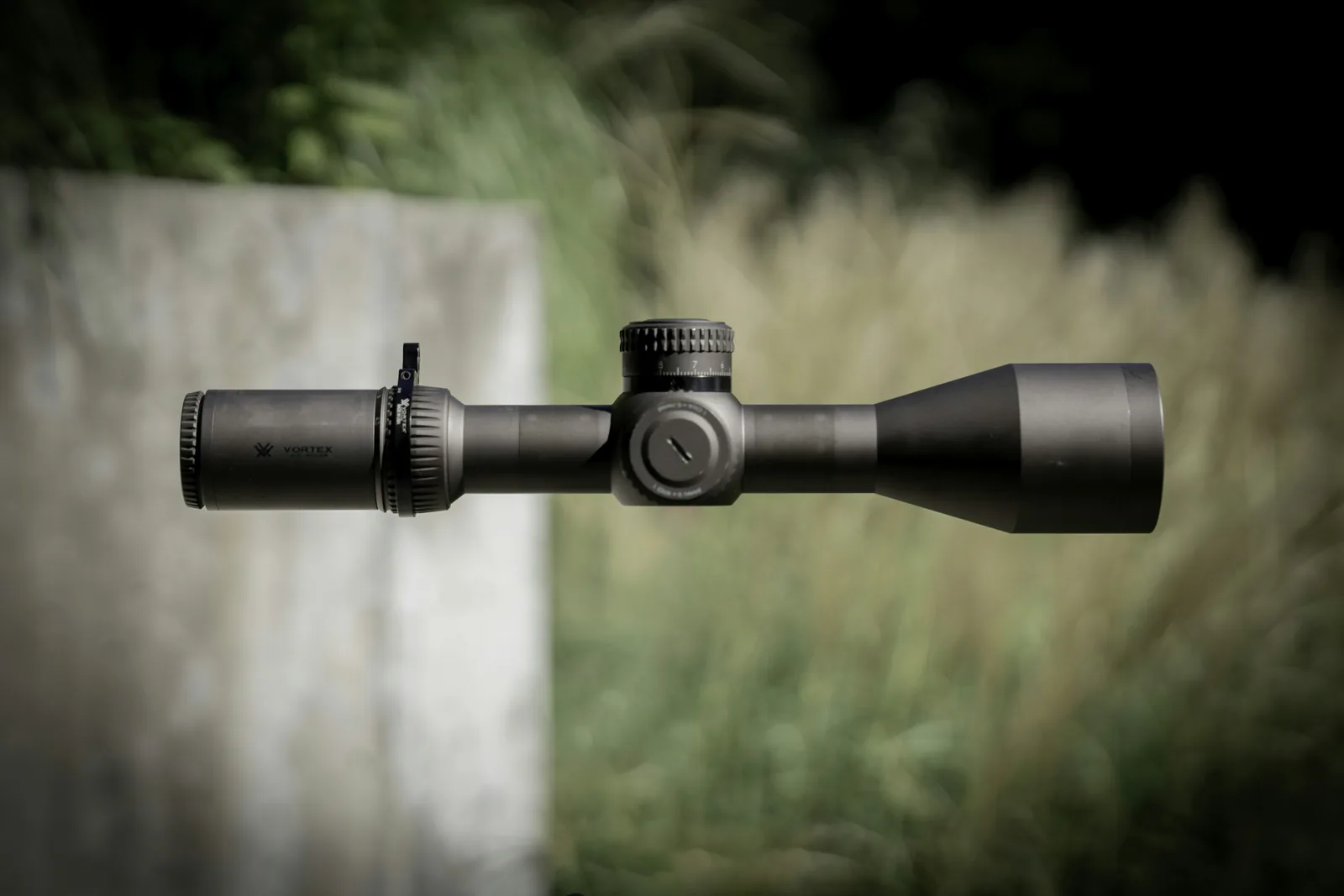
Eye relief is the distance between your eye and the scope’s rear (ocular) lens at which you see the full, sharp image with no black ring around the edge. Most centerfire rifle scopes list about 3.5 to 4 inches, scout scopes around 9 to 12 inches, and handgun scopes 10 inches or more. Get it wrong and you either see a shrinking tunnel, or you sit so close that recoil drives the eyepiece into your eyebrow.
This guide explains what the number on the spec sheet means, why it changes with magnification, how much you need for your rifle, and how to set it when you mount a scope. The figures below come from manufacturer spec pages, listed under Sources at the end.
Eye relief in plain terms
A riflescope projects its image out of the eyepiece as a small circle of light called the exit pupil. Your eye has to sit where that circle forms. Manufacturers measure eye relief as the distance from the outer surface of the ocular lens to that point.
Move your eye forward of the sweet spot and the edges blur or black out. Move it back and the image shrinks into a narrow tunnel surrounded by a dark ring. Warne Scope Mounts describes the target as a “full sight picture” without vignetting, meaning you don’t need to shift your head forward, back, up or down to see edge to edge.
Eye relief vs eye box
The two terms get mixed up at the range, but they describe different things. Eye relief is a single distance, front to back. The eye box is the whole volume behind the scope where you still get a usable image, including how far you can move up, down and sideways. Swampfox Optics calls a scope that blacks out with tiny head movements a “tight” eye box and one that tolerates a sloppy cheek weld a “generous” one.
A scope can list generous eye relief and still have a tight eye box at high power. That is why two scopes with the same 3.9-inch spec can feel very different when you shoulder them quickly.
How much eye relief do real scopes have?
The table below collects published eye relief figures from manufacturer pages for several common scope types. Where the maker lists two numbers, the first is at the lowest magnification and the second at the highest.
| Scope type | Example model | Published eye relief | Source |
|---|---|---|---|
| Hunting scope, 3-9x | Leupold VX-Freedom 3-9×40 | 4.2 in (3x) / 3.7 in (9x) | Leupold spec page |
| Low-power variable (LPVO) | Vortex Strike Eagle 1-8×24 (AR-BDC2) | 3.5 in | Vortex spec page |
| FFP precision scope | Swampfox Kentucky Long 2-12×44 | 3.74 in (2x) / 3.54 in (12x) | Swampfox spec page |
| FFP long-range scope | Vortex Diamondback Tactical 6-24×50 FFP | 3.9 in | Vortex spec page |
| Scout scope | Burris Scout 2-7×32 | 9.2-12 in | Burris spec page |
| Handgun scope | Burris Handgun 2-7×32 | 11-21 in at 2x / 10-14 in at 7x | Burris spec page |
| Prism sight | General category | Usually about 2-3 in | Swampfox (general guidance) |
| Red dot / reflex sight | General category | Unlimited | Swampfox (general guidance) |
Three patterns stand out. First, conventional rifle scopes cluster tightly between about 3.5 and 4.2 inches, whether they are budget LPVOs or 24x long-range optics. Second, eye relief usually drops as you zoom in: the Leupold loses half an inch between 3x and 9x, and the Burris handgun scope’s usable range narrows from a 10-inch window at 2x to a 4-inch window at 7x. Third, scout and handgun scopes are a different class entirely, built to sit a foot or more from your eye.
Prism sights are the outlier people forget. Swampfox notes that because they use etched glass and internal magnification, prisms have a fixed eye relief like a traditional scope and must be mounted close to the eye. A prism mounted far forward like a red dot will not give you a usable picture.
Standard vs long eye relief
Bushnell groups rifle scopes into two bands: standard eye relief of 3.5 to 4 inches, common on centerfire rifles, and long eye relief above 4.5 inches. Bushnell’s own guidance is to buy a scope with at least 3.5 inches and go longer if your rifle recoils hard.
Long eye relief scopes exist for specific setups rather than as a general upgrade:
- Scout rifles. Burris designs its Scout 2-7×32 to mount forward of the ejection port, which keeps the port clear for loading and lets you shoot with both eyes open.
- Handguns. A pistol is held at arm’s length, so the scope must project its image a foot or more back. Burris lists 11 to 21 inches at low power for its 2-7×32 handgun scope.
The trade-off is magnification and field of view. Long eye relief scopes generally top out at low power, which is why both Burris examples above stop at 7x.
Why eye relief matters: recoil and consistency
Scope bite
When a rifle fires, it moves back into your shoulder. If your eye sits too close to the eyepiece, the scope’s rear edge can strike your brow, which shooters call scope bite or scope eye. Warne warns that anything under two inches on a heavy-recoiling rifle could injure your eye. That is the practical reason the industry standard lands at 3.5 inches or more for centerfire hunting scopes.
Wear eye protection whenever you shoot. Correct eye relief reduces the risk of scope bite but does not replace shooting glasses.
Shooting position and clothing change the distance
The eye relief on the spec sheet is fixed, but where your eye ends up is not. Swampfox points to three common causes:
- Heavy clothing. A rifle set up in a T-shirt in September sits farther from your eye once you add a thick jacket in November, which can bring back the black ring.
- Prone vs bench. Lying prone tends to push your head forward on the stock compared with sitting at a bench, which puts your eye closer to the glass.
- Chest gear. Plate carriers and chest rigs add bulk that effectively lengthens the stock.
Bushnell adds that eye relief effectively shortens when shooting steeply uphill, as your head creeps forward on the stock. If you hunt mountain terrain, leave extra margin.
How to set eye relief when mounting a scope
This procedure follows the steps Warne and Swampfox publish for their mounts and scopes. Do it before the final torque on your rings, and before you level the reticle for good.
- Make the rifle safe. Unload it, open the action, keep your finger off the trigger and point it in a safe direction. Check the chamber and magazine twice.
- Snug the rings, don’t torque them. Warne recommends tightening just enough that the scope moves with a little effort but doesn’t slide on its own.
- Dress for the field. Wear the jacket, pack straps or chest rig you’ll actually shoot in.
- Turn a variable scope to its highest magnification. Eye relief is usually shortest at the top of the zoom range, so setting it there means the low end will also work. Swampfox gives the same advice for LPVOs: set them up at maximum magnification, or you may lose the image when you zoom in for a longer shot.
- Close your eyes and shoulder the rifle in your most common shooting position, prone, standing or seated.
- Open your eyes. If you see a dark ring or a shrinking image, note whether the scope is too far forward or too far back, then slide it in the rings and repeat.
- Aim for the middle of the window. Warne notes there is usually about an inch of acceptable eye relief. Setting the scope in the center of that range leaves room for position and clothing changes.
- Level the reticle and torque the rings to the scope manufacturer’s specification, being careful not to slide the scope fore or aft as you do.
If the scope cannot slide far enough in either direction, the problem is usually the mounting hardware rather than the scope. The mount’s ring spacing or the scope’s mounting space (the tube length available between the turret housing and the bell or eyepiece) may not line up with your rifle. Leupold, for example, publishes front and rear mounting space for each scope, 2.32 and 1.85 inches on the VX-Freedom 3-9×40, so you can check fit before buying rings. Offset or extended rings and cantilever mounts exist for this reason.
Troubleshooting: what the image tells you
| What you see | Likely cause | Fix |
|---|---|---|
| Black ring all around, image shrinks to a tunnel | Eye too far back | Slide scope rearward, or check if bulky clothing pushed the stock out |
| Edges blurry or blacked out, eye feels crowded | Eye too close | Slide scope forward; check for scope-bite risk on hard-recoiling rifles |
| Crescent shadow on one side | Eye off center (eye box, not eye relief) | Check cheek weld and ring height |
| Fine at low power, black ring at high power | Eye relief set at low magnification | Reset at maximum magnification |
| Image fine at the bench, dark ring in the field | Position or clothing changed | Re-check eye relief in field gear and your real shooting position |
A shadow on one side usually points to height rather than distance. Warne notes that if you have to lift your cheek off the stock to see through the scope, lower rings may help, provided the objective bell still clears the barrel. An adjustable cheek riser is the other common fix.
Eye relief and other scope settings
Eye relief is one of several adjustments that can look like an optical problem. A reticle that seems to drift on the target when you move your head is usually parallax, not eye relief. Our guide to parallax adjustment on a scope explains how to tell the difference. The eyepiece focus ring is a third, separate control: Burris tells owners to focus it by glancing at a plain wall or the sky until the reticle looks sharp and black, rather than staring through the scope, because your eye will adapt to a blurry reticle.
Focal plane does not change eye relief, but it does change how the reticle looks as you zoom, which affects how you use holdover marks at the magnification where your eye relief is tightest. See first focal plane vs second focal plane for that side of the decision.
FAQ
What is a good eye relief for a rifle scope?
For a centerfire rifle, 3.5 inches is the common minimum and 4 inches or more gives extra margin on hard-recoiling cartridges. Bushnell recommends at least 3.5 inches and more for heavy recoil. Scout and handgun setups need dedicated long eye relief scopes, typically 9 inches and up.
Can you adjust eye relief on a scope?
Not on the scope itself. The eye relief distance is fixed by the optical design, and on most variables it changes slightly with magnification. What you adjust is where the scope sits relative to your eye, by sliding it forward or back in the rings before final torque.
Why does eye relief get shorter at higher magnification?
At higher power the exit pupil gets smaller and the usable position for your eye becomes both shorter and less forgiving. Leupold’s VX-Freedom 3-9×40, for example, goes from 4.2 inches at 3x to 3.7 inches at 9x. That is why you set eye relief at maximum magnification.
What is a long eye relief scope?
Bushnell defines long eye relief as anything above 4.5 inches. In practice the term usually refers to scout scopes (around 9 to 12 inches) and handgun scopes (10 to 21 inches on the Burris example above), which are designed to be mounted well forward or held at arm’s length.
Do red dots have eye relief?
Not in the same sense. Red dots and reflex sights have effectively unlimited eye relief, so you can mount them anywhere on the rail. Prism sights are different: they have a fixed, fairly short eye relief and must be mounted close to the eye.
Sources
All checked October 22, 2026.
- Bushnell, “Eye Relief: Everything You Need to Know”: https://www.bushnell.com/blogs/field-notes/about-scope-eye-relief (standard vs long eye relief bands, 3.5 in minimum, uphill shooting)
- Warne Scope Mounts, “Proper Eye Relief on a Rifle Scope”: https://warnescopemounts.com/blog/proper-eye-relief-on-a-rifle-scope/ (setup steps, under-2-inch warning, about 1 inch acceptable range, ring height)
- Swampfox Optics, “Understanding Rifle Scope Eye Relief and Eye Box”: https://www.swampfoxoptics.com/understanding-rifle-scope-eye-relief-and-eye-box (eye box, clothing/position effects, prism and red dot behavior, LPVO setup)
- Leupold VX-Freedom 3-9×40 specifications: https://www.leupold.com/vx-freedom-3-9×40-hunt-plex-riflescope (eye relief 4.2/3.7 in, mounting space 2.32/1.85 in)
- Vortex Strike Eagle 1-8×24 (AR-BDC2) specifications: https://vortexoptics.com/vortex-strike-eagle-1-8×24-ar-bdc2-moa-riflescope.html (eye relief 3.5 in)
- Vortex Diamondback Tactical 6-24×50 FFP specifications: https://vortexoptics.com/vortex-diamondback-tactical-6-24×50-ffp-riflescope.html (eye relief 3.9 in)
- Swampfox Kentucky Long specifications: https://www.swampfoxoptics.com/kentucky-long-series (2-12×44 eye relief 3.74-3.54 in)
- Burris Scout Riflescope 2-7×32 specifications: https://www.burrisoptics.com/riflescopes/scout-riflescope-2-7x32mm (eye relief 9.2-12 in, forward mounting)
- Burris Scout user guide (eyepiece focusing): https://www.burrisoptics.com/sites/default/files/content/files/2023-03/scoutuserguide.pdf
- Burris Handgun Scope 2-7×32 specifications: https://www.burrisoptics.com/riflescopes/handgun-scope-2-7x32mm (eye relief 11-21 in at low, 10-14 in at high)