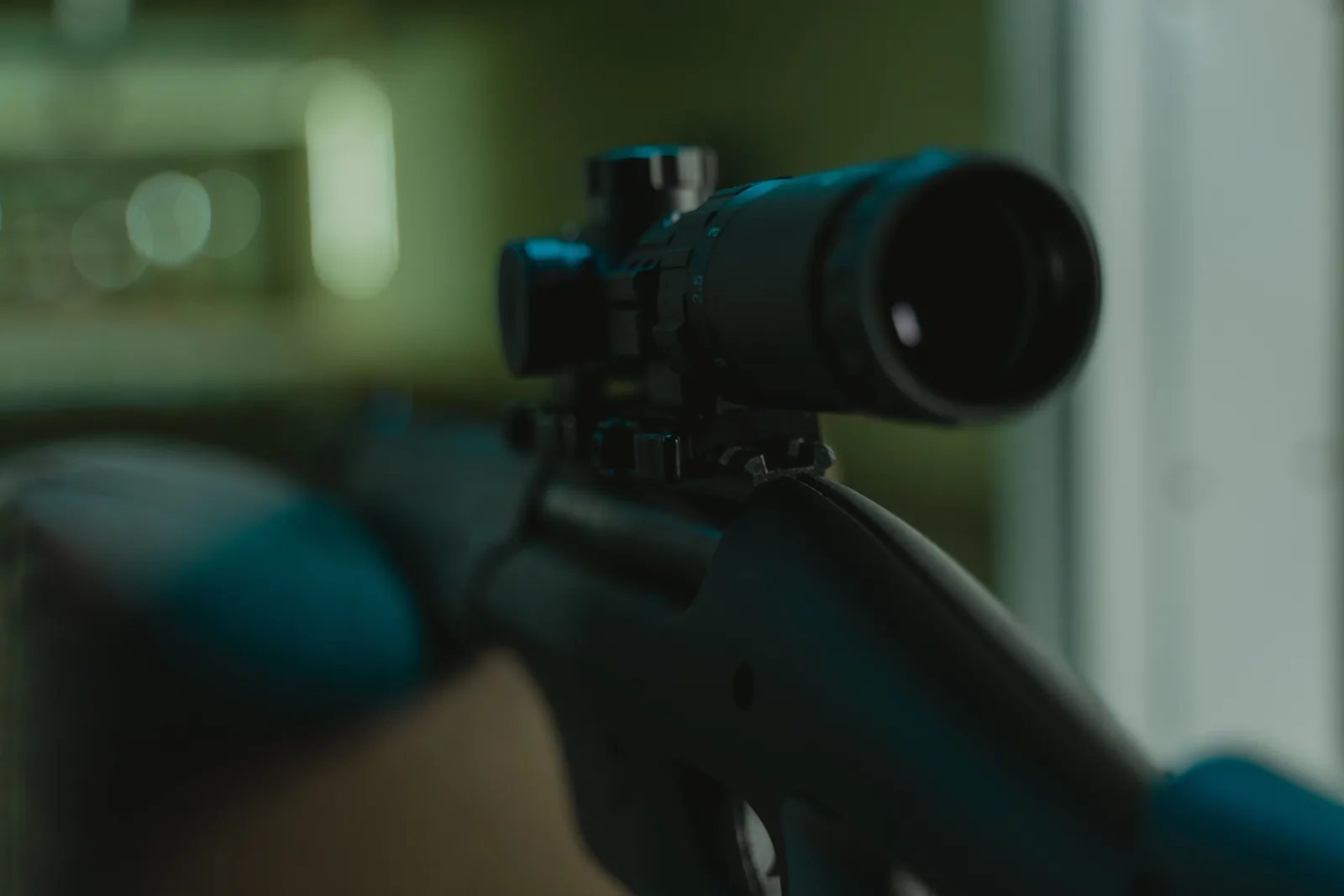
The numbers on a scope tell you how much it magnifies and how big its front lens is. On a 3-9×40 scope, “3-9x” means you can zoom anywhere from 3 times to 9 times magnification, and “40” is the diameter of the objective (front) lens in millimeters. A fixed-power scope shows a single number instead of a range, so a 4×32 always magnifies 4 times and has a 32mm objective.
That covers the label most people ask about. A real scope carries more numbers than that, though: the tube diameter, the click value on the turrets, the travel range, and on the spec sheet field of view and eye relief. This guide decodes all of them, then shows the one number manufacturers rarely print on the box but you can work out in five seconds: the exit pupil.
The short version: reading a full scope name
Retail listings often string everything into one line. Here is a made-up but typical example, decoded token by token:
4-16×44 AO IR FFP MRAD, 30mm
| Marking | What it means | What it affects |
|---|---|---|
| 4-16x | Magnification range: 4x at the lowest setting, 16x at the highest | How close the target looks; field of view |
| 44 | Objective lens diameter in millimeters | Light gathering, scope weight, ring height |
| AO | Adjustable objective: parallax is set with a ring on the front bell | Parallax correction at different distances |
| SF (if shown) | Side focus: parallax is set with a knob on the left side of the turret housing | Same job as AO, easier to reach from the shooting position |
| IR | Illuminated reticle | Reticle visibility in low light |
| FFP / SFP | First or second focal plane: where the reticle sits in the optical path | Whether holdover marks stay accurate at every magnification |
| MOA / MRAD (MIL) | The angular unit of the turrets and reticle | How far each click moves the point of impact |
| 30mm | Main tube diameter | Which rings fit; internal adjustment room |
The sections below explain each one, in the order you will meet them on the scope itself.
Magnification range: the first numbers
The number or range before the “x” is magnification, also called power. At 3x, an object looks three times larger (or closer) than it does to your naked eye. On a variable scope you turn the power ring on the eyepiece to move between the low and high end. A fixed scope has one setting; Leupold notes that fixed scopes typically come in 2.5x, 4x or 6x and trade flexibility for simplicity and a lower price.
More magnification is not automatically better. Leupold and EuroOptic both point out the costs: the field of view gets smaller as power goes up, so moving or close targets are harder to find, and every wobble of the rifle is magnified too. EuroOptic describes a 3-9×40 as an all-purpose setup for whitetail and general shooting out to about 300 yards, and 6-24x for long-range work such as steel beyond 600 yards.
Zoom ratio: the hidden number in the range
Divide the top magnification by the bottom one and you get the zoom ratio. A 3-9x, 4-12x and 5-15x are all 3:1 zoom scopes. A 3-15x or 5-25x is 5:1; a 2-12x or 4-24x is 6:1. Leupold builds this into some model names: per Leupold, a VX-5HD or Mark 5HD uses a 5:1 ratio and a VX-6HD a 6:1 ratio, while the VX-Freedom series is 3:1 without a number in its name.
The ratio tells you how much ground one scope tries to cover. A 3:1 scope is simpler and usually lighter. A 5:1 or 6:1 scope covers both close, fast shots and long, slow ones, with more glass and moving parts to do it.
Objective lens: the number after the “x”
The last number in the name is the objective lens diameter in millimeters. A 3-9×40 has a 40mm front lens; a 5-25×56 has a 56mm lens. Leupold lists common objective sizes from 32mm up to 56mm.
A bigger objective collects more light. Steiner’s glossary puts the relationship in numbers: light-gathering power scales with the square of the diameter, so doubling the diameter quadruples the light collected. The trade-offs are weight and height. A larger bell sits higher above the barrel, so it often needs taller rings, which in turn changes how your cheek meets the stock. EuroOptic’s rule of thumb: a 40mm lens usually fits low or medium rings, a 50mm lens medium or high, and a 56mm lens almost always needs high rings or a raised cheek piece.
Exit pupil: the number you calculate yourself
The objective size alone does not tell you how bright the image will look. What reaches your eye is the exit pupil: the diameter of the beam of light leaving the eyepiece. Steiner and Vortex give the same formula:
Exit pupil (mm) = objective diameter (mm) / magnification
Steiner notes that the human eye dilates to roughly 5 to 7.5mm once it adapts to the dark, and that the closer the exit pupil is to your dilated pupil, the brighter the image looks. That is why a scope that looks fine at noon can feel dark in the last minutes of shooting light when it is turned up to full power: the exit pupil has shrunk well below what your eye can take in.
Here are the calculated exit pupils for common scope sizes at the lowest and highest settings (rounded to one decimal):
| Scope | Zoom ratio | Exit pupil at low power | Exit pupil at high power | Highest power that still gives 5mm |
|---|---|---|---|---|
| 4×32 (fixed) | fixed | 8.0mm | 8.0mm | n/a (always 8.0mm) |
| 2-7×32 | 3.5:1 | 16.0mm | 4.6mm | about 6.4x |
| 3-9×40 | 3:1 | 13.3mm | 4.4mm | 8x |
| 3-9×50 | 3:1 | 16.7mm | 5.6mm | 9x (full range) |
| 4-12×40 | 3:1 | 10.0mm | 3.3mm | 8x |
| 4-16×44 | 4:1 | 11.0mm | 2.8mm | about 8.8x |
| 3-15×44 | 5:1 | 14.7mm | 2.9mm | about 8.8x |
| 3-15×56 | 5:1 | 18.7mm | 3.7mm | about 11x |
| 6-24×50 | 4:1 | 8.3mm | 2.1mm | 10x |
| 5-25×56 | 5:1 | 11.2mm | 2.2mm | about 11x |
The last column is the useful one for low-light hunting. It shows that a 56mm objective does not make a 25x scope bright at 25x; it lets you run around 11x before the exit pupil drops under 5mm. It also shows why a 3-9×50 suits dawn and dusk: it stays above 5mm through its whole range. The formula ignores glass quality and coatings, which Steiner lists as separate factors in brightness, so treat the table as a geometry comparison, not a brightness ranking between brands.
Tube diameter: 1 inch, 30mm or 34mm
The main tube is the long middle section of the scope that sits in the rings. Common sizes are 1 inch, 30mm and 34mm, and Weaver mentions 36mm and 40mm on some newer designs. The rule that matters most: the rings must match the tube. A 30mm scope needs 30mm rings and a 1-inch scope needs 1-inch rings.
A bigger tube does not make the picture brighter. Weaver states this directly: brightness comes from the objective lens and coatings, while a larger tube gives the maker more internal room for elevation and windage travel and tends to be stiffer. That is why long-range scopes with lots of turret travel usually have 30mm or 34mm tubes, and why light hunting scopes still often use 1-inch tubes.
Turret numbers: MOA or MIL, click value and travel
The top turret adjusts elevation and the right-hand turret adjusts windage. The numbers on them are in one of two angular units:
- MOA (minute of angle): 1 MOA is 1.047 inches at 100 yards, usually rounded to 1 inch. Many hunting scopes click in 1/4 MOA steps, so four clicks move impact about 1 inch at 100 yards.
- MRAD or MIL (milliradian): 1 mil is 3.6 inches at 100 yards, or 10cm at 100 meters. Mil scopes commonly click in 0.1 mil steps, which is 0.36 inches at 100 yards.
Leupold notes that MOA is favored by American hunters and mils by armed forces, and that both work equally well for most uses. Turrets and reticle should use the same unit, so a holdover read on the reticle converts directly into clicks. Check the turret cap: Steiner points out the click value is often printed there.
The spec sheet adds two more turret numbers. Adjustment range (or total travel) is how far you can move the reticle from one end to the other; adjustment per revolution is how much one full turn of the knob covers. Both matter if you plan to dial for distance rather than hold over.
Parallax numbers and the side focus knob
If your scope has an AO ring or side focus knob, it will be marked in yards (or meters) and sometimes an infinity symbol. You turn it until the target is sharp and the reticle stops shifting when you move your head. Scopes without adjustment are set parallax-free at a fixed distance, often 100 or 150 yards, which appears on the spec sheet. We cover how to set it in our guide to parallax adjustment on a scope.
Worked example: reading a real spec sheet
Labels only go so far. Here is the spec sheet for one common 3-9×40, the Leupold VX-Freedom 3-9×40 Hunt-Plex (part 181307), as listed on Leupold’s product page, with what each line tells you:
| Spec line | Value | What it tells you |
|---|---|---|
| Magnification | 3-9x | 3:1 zoom ratio |
| Objective lens | 40mm | Exit pupil 13.3mm at 3x, 4.4mm at 9x |
| Linear field of view | 33.1 ft at 3x, 13.6 ft at 9x (at 100 yd) | How wide a slice of the world you see |
| Eye relief | 4.2 in at 3x, 3.7 in at 9x | Where your eye must sit; it changes with power |
| Click value | 1/4 MOA | 4 clicks = about 1 inch at 100 yd |
| Elevation / windage range | 60 MOA each | Total travel available for zeroing and dialing |
| Adjustment per revolution | 15 MOA | 60 clicks per full turn of the turret |
| Reticle focal plane | Second focal plane | Reticle stays the same size when zooming |
| Fixed parallax-free distance | 150 yd | No parallax knob; set at the factory |
| Weight | 12.2 oz | Light enough for a carry rifle |
Two things stand out. First, the field of view does not shrink by the full zoom ratio: tripling the magnification cuts the field from 33.1 to 13.6 feet, a factor of about 2.4. So compare published field-of-view numbers between scopes instead of estimating them from magnification. Second, eye relief is listed as two numbers because it shortens at high power. Our eye relief guide explains how to set the scope position with that in mind.
How to use the numbers when comparing scopes
Once you can read the label, a few rules of thumb from the sources above sort most decisions:
- Pick the magnification range from your longest realistic shot and your closest one. Leupold suggests a 3-15x range covers most hunting between 50 and 500 yards. If most shots are in timber under 150 yards, the low number matters more than the high one.
- Check the exit pupil at the power you will actually use at dawn and dusk. If it falls under about 5mm there, a bigger objective or lower power helps more than more zoom.
- Match the tube to rings, and the objective to ring height. Leupold warns that a larger objective may need taller mounts so the scope doesn’t touch the rifle.
- Match turret and reticle units. MOA turrets with a MIL reticle force a conversion at the worst moment.
- Read FFP or SFP before using holdover marks. On a second focal plane scope, reticle subtensions are only correct at one magnification set by the manufacturer. Our first vs second focal plane guide covers that choice in detail.
FAQ
What does 3-9×40 mean on a scope?
It means the magnification adjusts from 3x to 9x and the objective lens is 40mm across. The exit pupil works out to 13.3mm at 3x and 4.4mm at 9x.
What does 4×32 mean on a scope?
It is a fixed-power scope: 4x magnification with a 32mm objective lens. There is no zoom ring, and the exit pupil is always 8mm.
Is a bigger objective lens always better?
No. It gathers more light, but it adds weight and height and often needs taller rings. It helps brightness most when magnification is high enough that a smaller lens would give an exit pupil under about 5mm. At 3x, even a 40mm lens gives a 13.3mm exit pupil, larger than a fully dilated eye.
What do the numbers on a scope turret mean?
They count clicks in MOA or MIL. A 1/4 MOA turret moves the point of impact about 1/4 inch at 100 yards per click; a 0.1 MIL turret moves it 0.36 inches at 100 yards per click.
Does a 30mm tube mean a brighter scope?
No. According to Weaver, brightness comes from the objective lens and coatings. A 30mm tube mainly gives more internal adjustment range and a stiffer body, and it requires 30mm rings.
Sources
All checked October 24, 2026. Exit pupil values in the tables are our calculations from the formula above.
- Leupold, “Understanding the Numbers on Your Riflescope”: leupold.com/blog/post/understanding-the-numbers-on-your-riflescope (zoom ratio, model naming, objective sizes, mount height, MOA vs MIL)
- Leupold, “Riflescope Magnification 101”: leupold.com/blog/post/magnification-101 (fixed vs variable, 3:1 examples, 3-15x for 50-500 yards)
- Leupold VX-Freedom 3-9×40 Hunt-Plex product specifications: leupold.com/vx-freedom-3-9×40-hunt-plex-riflescope (all values in the worked example)
- Steiner, Riflescope Glossary: steiner-optics.com/resources/glossary/riflescope-glossary (exit pupil formula, 5-7.5mm eye dilation, light-gathering power, MOA 1.047 in, mil 3.6 in at 100 yd, click values, parallax preset)
- Vortex, “What Makes Great Low-Light Performance”: vortexoptics.com/blog/what-makes-great-low-light-performance.html (exit pupil formula)
- EuroOptic, “What Do All Those Scope Numbers Really Mean?”: eurooptic.com/blog/post/scope-numbers-explained (use cases for 3-9×40 and 6-24x, objective size vs ring height)
- Weaver, “1-Inch vs. 30mm vs. 34mm Scope Tubes”: weavermounts.com/articles/1-inch-vs-30mm-vs-34mm-scope-tubes-matching-your-rings/ (ring matching, tube size vs brightness and travel)
- Vector Optics, “AO Scope vs. SF Scope”: vector2007.com/blogs/new/what-are-ao-scope-and-sf-scope-2 (AO and SF definitions)