If you shoot at a fixed distance with the scope near full power most of the time, an SFP scope works fine. If you dial magnification up and down during a shot sequence and use reticle holdovers instead of dialing the turrets, an FFP scope eliminates a step of mental math. That’s the short answer. The longer one requires understanding what’s actually happening inside the scope.
What a Focal Plane Is
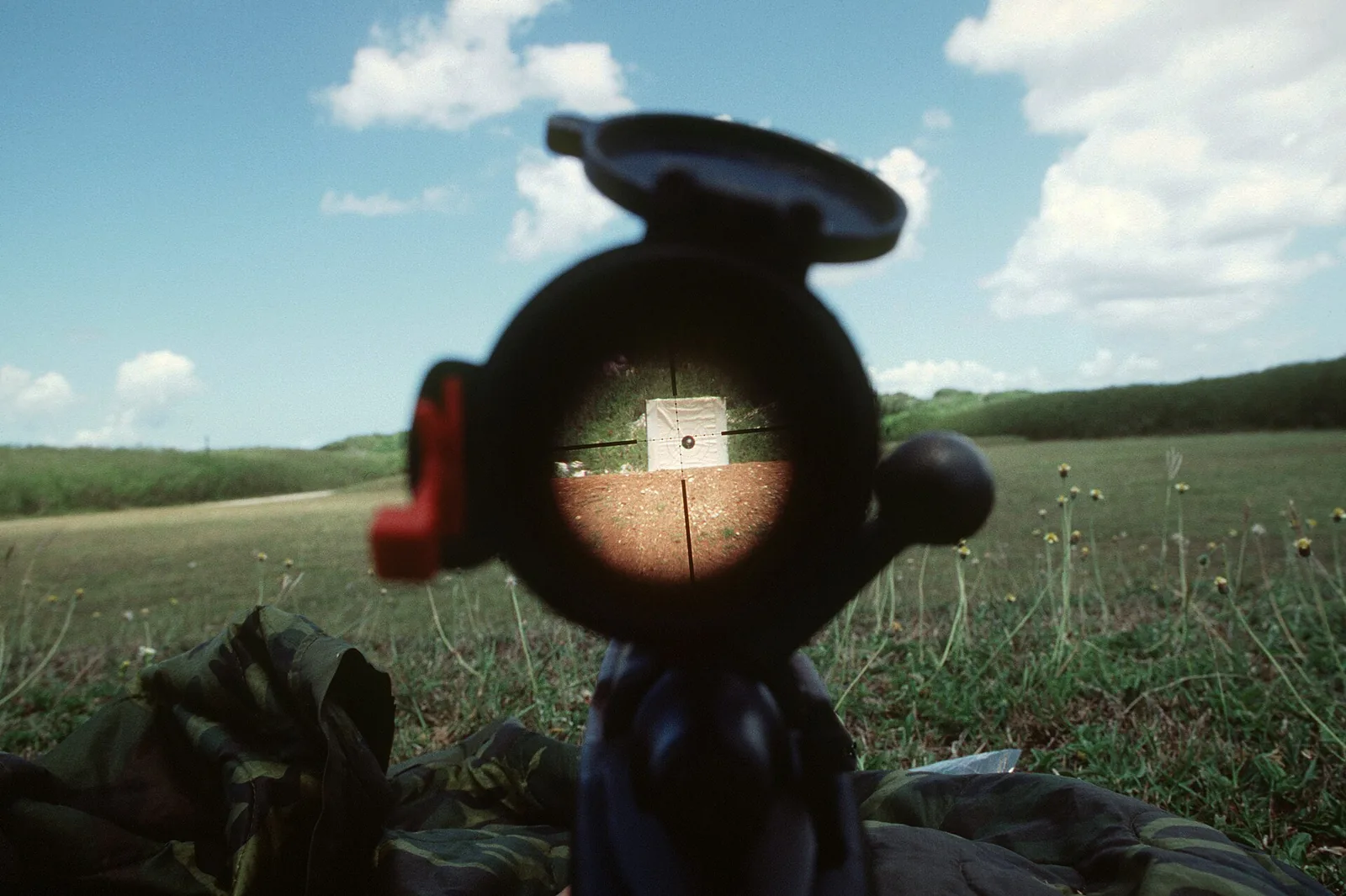
Inside every variable-power rifle scope there are two locations where a reticle can physically sit. Both locations are called focal planes because that’s where the light converges into a focused image at that point in the optical path.
The first focal plane (FFP) — also called the front focal plane — sits in front of the erector system, the set of lenses that handles magnification. Anything placed here gets magnified along with the target image.
The second focal plane (SFP) — also called the rear focal plane — sits behind the erector system, between the magnification lenses and your eye. The reticle here never moves through the erector system, so it never changes size.
Leupold uses the terms front focal plane and rear focal plane; most other manufacturers say first and second. They mean the same thing. The table below maps the common variants:
| Term | Abbreviation | Also Called |
|---|---|---|
| First Focal Plane | FFP | Front focal plane |
| Second Focal Plane | SFP | Rear focal plane |
How Each Focal Plane Behaves
First Focal Plane (FFP)
As you increase magnification, the reticle grows proportionally with the target image. At 6x, the reticle subtensions cover the same angular measurement they cover at 18x. One Mil hash mark equals one Mil at every power setting. One MOA hash mark equals one MOA at every power setting.
The trade-off: at low magnification the reticle shrinks, sometimes to the point where fine hash marks are hard to distinguish. At high magnification the reticle can appear thick relative to the target, especially with older or lower-quality glass.
Second Focal Plane (SFP)
The reticle stays the same physical size regardless of magnification. The target image grows and shrinks; the reticle lines do not. This keeps the reticle bold and easy to see at all magnification settings.
The trade-off: because the reticle doesn’t scale with the image, the angular value represented by each hash mark changes as you turn the power ring. Manufacturers calibrate the subtensions to be accurate at one specific magnification — almost always the maximum power, though some scopes use a lower calibration point and mark it on the power ring with a dot or indicator.
The SFP Holdover Math: How to Read Your Reticle Off-Power
This is where most explanations stop short. If your SFP scope has MOA hash marks calibrated at 16x, and you’re currently set to 8x (half power), each hash mark now subtends double the stated value: 2 MOA instead of 1 MOA. At 4x (one-quarter power), each hash represents 4 MOA.
The formula is straightforward:
Actual subtension = Stated subtension × (Calibration magnification ÷ Current magnification)
Example: Calibration at 16x, current power 10x, stated hash value 1 MOA.
Actual value = 1 MOA × (16 ÷ 10) = 1.6 MOA per hash.
For most deer hunters dialing to full power before the shot, this calculation is irrelevant — they never use the holdover marks at reduced power. For a PRS competitor who might be at 8x for a close steel target and 24x for a distant one, the math matters on every stage.
Magnification Range: The Key Variable
How much the focal plane choice matters depends heavily on how wide your scope’s magnification range is. A fixed-power scope has no focal plane trade-off at all — the image never changes size. The wider the power range, the more the choice matters.
| Scope Type | Example Power Range | FFP Benefit | SFP Benefit |
|---|---|---|---|
| Fixed power | 10x fixed | None (no magnification change) | None (no magnification change) |
| Low-range variable | 3-9x | Small; holdover marks rarely used | Good; reticle stays visible |
| LPVO (low-power variable) | 1-6x, 1-8x, 1-10x | Reticle shrinks a lot at 1x | Bold reticle at 1x; faster CQB |
| Mid-range variable | 4-16x, 5-25x | Strong; reticle still visible throughout | Works, but holdover math at mid-power |
| High-power variable | 6-24x, 7-35x | Strongest case; precision holdovers at any power | Acceptable if always shooting at max power |
The LPVO Case: Why Most 1-10x Scopes Are SFP
Low-power variable optics (LPVOs) that run from 1x up to 6x, 8x, or 10x present a specific challenge for FFP designs. At 1x, the erector system has compressed the image down to true-size. An FFP reticle at 1x is also at its smallest — sometimes reduced to just a thin crosshair that disappears against a dark background or a moving target at close range.
This is why most LPVOs are SFP. A bold, consistent reticle at 1x is a speed requirement for close-range shots. At 1x you want a clear aiming point immediately. The holdover hash marks matter less at that distance.
Some premium LPVO manufacturers offer FFP options in their 1-8x and 1-10x lines, typically paired with an illuminated reticle to compensate for the small reticle at low power. Those designs solve the visibility problem with illumination rather than reticle placement.
How Illumination Interacts With Focal Plane Choice
An illuminated reticle changes the calculus slightly, especially for FFP scopes at low magnification.
On an SFP scope, illumination affects only the brightness of an already-constant-size reticle. Visibility is consistent across all magnifications; the light source adds contrast in bright conditions or at dawn and dusk.
On an FFP scope at low magnification, the reticle is physically small. Illumination helps — a glowing center dot or crosshair becomes visible even when the surrounding hash marks are too fine to see clearly. This is why many FFP scopes designed for dynamic shooting use a daylight-bright illuminated center to compensate for the small reticle at low power.
If you’re choosing an FFP scope for use at lower magnifications (1-6x range), an illuminated reticle is a practical necessity rather than a convenience feature.
Decision Framework: Which Focal Plane Fits Your Shooting
Rather than a blanket recommendation, here’s a decision path based on how you actually shoot:
Choose FFP if:
- You use reticle holdovers for wind and elevation corrections across a range of distances, and you want those holds accurate at any magnification setting
- Your scope has a wide magnification range (5x or more ratio, e.g., 4-20x or 5-25x) and you routinely change power between shots
- You shoot PRS, NRL22, or tactical competitions where the course of fire requires quick transitions between close and distant targets
- You want to confirm your position on the reticle without worrying about what magnification you’re currently at
Choose SFP if:
- You hunt at relatively fixed distances and typically dial to full power before the shot — holdover math is not part of your routine
- Your scope is a 1-6x or 1-8x LPVO and you need a fast, visible reticle at 1x for close shots
- You prefer a bold, consistent reticle that looks the same at 3x and 12x
- Your scope has a narrow magnification range (3x ratio or less, e.g., 3-9x) where the FFP benefit is minimal
Either works when:
- You shoot primarily at a single distance and power setting
- You don’t use the reticle subtensions for holdovers — you dial to zero for every shot
Frequently Asked Questions
Is first focal plane always more accurate?
No. Both focal plane types produce the same mechanical accuracy. The difference is in when the reticle subtensions are accurate: FFP at all magnifications, SFP only at the calibration power. A shooter who always dials to full power on an SFP scope gets equally accurate holdovers as an FFP shooter.
Why do FFP scopes tend to cost more?
Manufacturing a reticle that maintains consistent subtension accuracy across the full magnification range requires tighter tolerances in the erector system. More glass is involved in keeping the image flat and the reticle proportional at both ends of the zoom range, which adds manufacturing cost. This gap has narrowed in mid-range optics over the past decade.
At what magnification are SFP reticle marks accurate?
Check your scope’s manual — the manufacturer specifies the calibration magnification. Most modern SFP scopes calibrate subtensions at maximum magnification. Some older designs use a mid-power calibration point and mark it with a small indicator dot on the power ring.
Can I use holdovers on an SFP scope at reduced magnification?
Yes, but apply the conversion: Actual subtension = Stated subtension × (Calibration power ÷ Current power). At half the calibration magnification, each hash is worth twice the stated value. The math takes a moment but the scope is fully usable at any power once you know it.
Do European scopes use different focal plane conventions?
Most follow the same FFP/SFP conventions but may use different terminology in their manuals. Leupold (US) uses front/rear rather than first/second. The optical principle is identical regardless of origin.
Sources
- Leupold & Stevens, Inc. “Front Focal Plane Optics vs. Rear Focal Plane Optics.” leupold.com, published August 8, 2018. Checked October 2026.
- Outdoorsmans. “Rifle Scopes: First Focal Plane vs. Second Focal Plane.” outdoorsmans.com, July 30, 2024. Checked October 2026.
- MDT Sporting Goods / Rob Orgel, Emergency Response Tactical. “First Focal Plane vs Second Focal Plane.” mdttac.com, April 29, 2026. Checked October 2026.