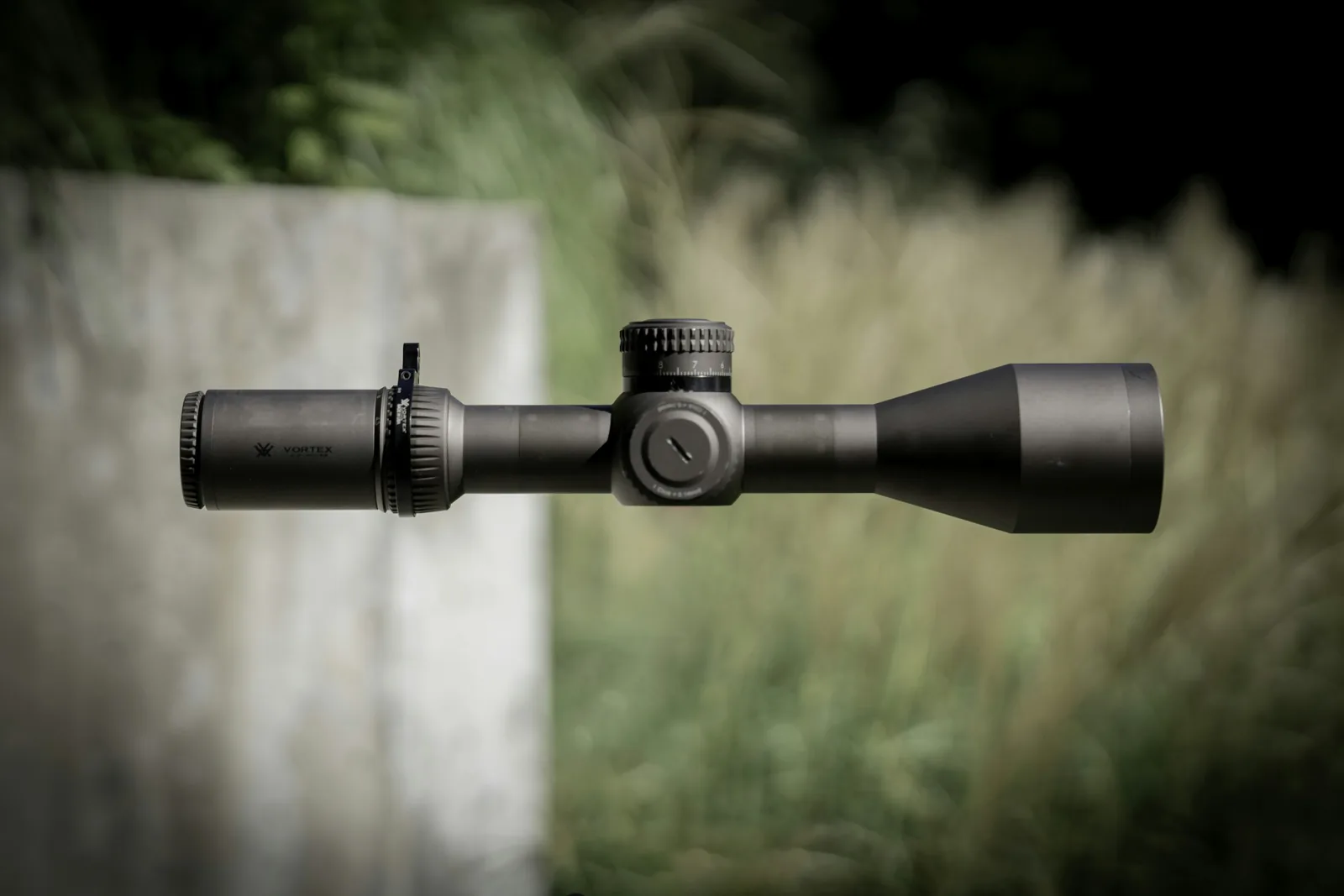
Parallax adjustment is the control on a rifle scope (usually a side-focus knob or an adjustable objective ring) that moves the image of the target onto the same focal plane as the reticle. When the two sit on the same plane, the crosshair stays fixed on your aiming point even if your eye is slightly off-center behind the scope. When they don’t, the reticle appears to drift across the target as your head moves, and your shot goes where the reticle drifted, not where you thought you were aiming.
Below: what parallax is in plain terms, how big the error really gets, how to set the knob in the right order, and a simple way to decide whether you need adjustable parallax at all.
Parallax in one paragraph
Inside a scope, the objective lens forms an image of the target somewhere along the tube. The reticle sits at a fixed spot. For one distance, the target image lands exactly on the reticle’s plane. At any other distance, the image lands a tiny bit in front of or behind it. Look straight down the center of the scope and you still see the right aiming point. Look in at a slight angle and the reticle and the target image shift relative to each other, the same way a nearby fence post seems to move against distant hills when you move your head. Field & Stream summarizes the fix simply: the parallax adjustment “positions the reticle focus and the image focus at the same spot.”
How big is parallax error? A real number
Most explanations stop at “it can affect accuracy.” Swarovski Optik’s service documentation gives an actual figure. Their hunting scopes are factory-set to be parallax-free at 100 m (109 yd). With that setting and a target at 250 m (273 yd), the target image sits about 0.164 mm (0.0065 in) in front of the reticle, which Swarovski compares to the thickness of two sheets of paper. That tiny offset produces a maximum aiming error of 3.7 cm (about 1.5 in) at 250 m.
Two things follow from that number:
- It is a worst case. The error only appears when your eye is off the scope’s optical axis. With a consistent cheek weld and your eye centered, it shrinks toward zero.
- It matters more as the target gets smaller. An inch and a half at 273 yards is irrelevant on a deer’s vital zone but large on a small steel plate or a precision-match target.
That is why Outdoorsmans describes parallax as “generally not an issue at ranges of less than 150 yards,” while long-range and precision shooters treat the parallax knob as part of every shot setup.
The three ways scopes handle parallax
| Type | Where the control is | Typical factory setting / range | Main trade-off |
|---|---|---|---|
| Fixed parallax | None (set at the factory) | Often 100 or 150 yd on low-power hunting scopes; often 50 yd on rimfire scopes | Simple and light, but parallax-free at only one distance |
| Side focus | Knob on the left side of the turret housing, moving an internal lens | Marked in yards, usually from close range to infinity | Easy to reach from a shooting position; adds cost |
| Adjustable objective (AO) | Ring on the objective bell at the front of the scope | Marked in yards on the bell | Works well, but you have to reach forward to turn it; Outdoorsmans calls it less precise than a dial with yardage indicators |
Sources for the table: Armament (types of compensation and typical fixed settings), Brink Excursions (50 yd rimfire / 100 yd general-purpose fixed settings), Outdoorsmans (AO vs side-focus precision). Your own scope’s manual is the final word on its fixed parallax distance.
Parallax knob vs. eyepiece focus: two different jobs
A lot of confusion comes from scopes having two focus controls. They do different things, and you set them in a fixed order.
- Diopter (eyepiece) focus adjusts the reticle to your eye. It has nothing to do with the target’s distance. Set it once per shooter.
- Parallax (side focus or AO) moves the target image onto the reticle’s plane. It changes with the target’s distance.
If you use the parallax knob to sharpen a reticle that is blurry because the diopter is wrong, you will end up with a sharp-looking image that still has parallax. Outdoorsmans makes the same point: get the reticle in focus first, “this adjustment will ensure that your parallax correction is valid.”
How to adjust parallax, step by step
- Set the diopter first. Point the scope at a plain, bright background at least five yards away (a clear sky or blank wall works). Turn the eyepiece until the reticle is crisp the instant you look. Don’t stare for long while adjusting, because your eye will try to compensate.
- Go to high magnification. Parallax is easiest to see at maximum power, and Outdoorsmans recommends setting it there.
- Get the rifle stable. Use a bipod, bags or a rest so the rifle stays still while your head moves. If the rifle moves, you can’t tell rifle movement from parallax.
- Start from the dial marking. Turn the knob to the yardage closest to the target distance. The marks are a starting point, not an exact setting.
- Do the head-movement test. Keep the rifle still and move your head slightly up and down (or side to side) behind the eyepiece. If the reticle stays locked on the aiming point, you’re done.
- Turn in the right direction. Armament gives a useful rule for an up-and-down head movement: if the reticle seems to bounce downward, turn the knob toward a closer distance setting; if it bounces upward, turn toward a farther setting.
- Make fine corrections until the reticle no longer moves against the target as far as you can move your eye while still seeing a full image.
The NSSF’s Let’s Go Shooting guide describes the same loop: move your head, watch the crosshairs, adjust until “there is no movement of the crosshairs as you move your head.”
Common mistakes and what they look like
| Symptom | Likely cause | Fix |
|---|---|---|
| Target is sharp, reticle is fuzzy | Diopter not set for your eye | Reset the eyepiece against a plain background, then redo parallax |
| Image looks sharp but the reticle still moves when you shift your head | Focusing by image sharpness instead of using the head-movement test | Ignore sharpness, adjust until the reticle stops moving |
| Groups open up when shooting from awkward positions | Inconsistent cheek weld putting your eye off-axis, combined with uncorrected parallax | Set parallax for the distance and work on a repeatable head position |
| Dial reads 200 yd but target is at 300 yd and the reticle is stable | Normal: yardage marks are approximate | Trust the head-movement test over the numbers |
| Blurry target at close range on a fixed-parallax scope | Target is well inside the factory parallax distance | Expect it; a side-focus or AO scope is the fix if you shoot that close often |
On sharpness: Armament notes that image clarity is often, but not always, best when parallax is removed. That “not always” is the reason to use the head-movement test as the deciding check.
Do you need adjustable parallax? A decision framework
Parallax error grows with distance from the scope’s parallax-free setting, with higher magnification, and with how far your eye drifts off-center. So the real question is how far from the factory setting you shoot, how much magnification you use, and how small your targets are.
- Fixed parallax is usually fine if you hunt medium or large game inside roughly 150-200 yards with a low-power scope set at 100 yards. Per Swarovski’s numbers, even the worst case at 273 yards is about 1.5 inches, and a consistent cheek weld keeps you well under that.
- Side focus is worth having if you shoot steel or paper past 300 yards, compete in precision rifle matches, or regularly use high magnification. Small targets make the worst-case error visible, and changing distances means one fixed setting can’t fit them all.
- Rimfire shooters should check the factory setting. Many rimfire scopes are fixed at 50 yards, which suits typical .22 LR distances. If you shoot rimfire precision matches at varied distances, adjustable parallax removes one source of error.
- Air rifle shooters work at short distances where a centerfire scope’s fixed 100-yard setting is far off, so adjustable parallax that focuses close is standard on scopes built for airguns. Check the minimum focus distance in the manual before buying.
- Low-power variable optics at the bottom of their range are less affected because parallax error matters less at low magnification. This is one reason fixed-parallax designs are common on low-power optics (Armament).
If you are also choosing between reticle types for long-range work, our guide to first focal plane vs. second focal plane scopes covers how reticle position affects holdovers. It is a separate question from parallax: focal plane decides whether the reticle scales with magnification, while parallax decides whether the reticle and target image line up.
FAQ
What does the parallax adjustment do on a scope?
It moves the target image forward or backward inside the scope so it lands on the reticle’s focal plane. Once they match, the reticle stays on the same spot of the target even if your eye is not perfectly centered.
Is parallax the same as focus?
Not exactly. Side-focus knobs also sharpen the target image, which is why many people call them “focus,” but the goal is removing reticle movement. The eyepiece diopter is a separate control that focuses the reticle for your eye.
Do I need to adjust parallax for every shot?
Adjust it whenever the target distance changes meaningfully, especially at long range and high magnification. Outdoorsmans’ advice for a fixed distance is to set it at maximum magnification and then leave it.
Can I use the parallax dial as a rangefinder?
Only as a rough guess. The yardage marks are approximate starting points, so a laser rangefinder or known distance is far more reliable for holdover decisions.
Does parallax matter if my eye is perfectly centered?
Swarovski states that parallax error only occurs when the eye is outside the optical axis. In practice, a perfectly centered eye on every shot is hard to achieve in the field, which is why adjustable parallax helps at long range.
Sources
Checked October 17, 2026.
- Swarovski Optik service article, “What is a parallax?”: https://myservice.swarovskioptik.com/s/article/What-is-a-parallax (100 m factory setting, 0.164 mm offset and 3.7 cm maximum error at 250 m, eye-off-axis cause)
- Outdoorsmans, “Correcting and Adjusting Rifle Scope Parallax”: https://outdoorsmans.com/blogs/rifle-scopes/correcting-and-adjusting-rifle-scope-parallax (under-150-yard note, diopter-first order, five-yard background, set at max magnification, AO vs side focus)
- Armament, “Parallax Effect Explained”: https://armament.com/pages/parallax-effect-explained (types of compensation, typical fixed settings, direction rule, clarity note)
- NSSF Let’s Go Shooting, “What is Parallax Error on Rifle Scopes and How to Avoid It?”: https://www.letsgoshooting.org/resources/articles/rifle/what-is-parallax-error-on-rifle-scopes-and-how-to-avoid-it/ (head-movement adjustment steps)
- Field & Stream, “A Hunter’s Guide to Scope Parallax”: https://fieldandstream.com/stories/guns/what-is-scope-parallax (definition quote)
- Brink Excursions, “Understanding Rifle Scope Parallax: Fixed vs. Side Adjustable”: https://www.brinkexcursions.com/updates/scopes-101-understanding-rifle-scope-parallax-fixed-vs-side-adjustable (50 yd rimfire / 100 yd general fixed settings)